
A Monumental Undertaking
Borys Krylov and Oles Sidoruk are distinguished sculptors, working Ukrainian identity into huge monuments that defy the Russian onslaught.

Soviet public spaces were notoriously infested with giant stone Lenins. Every town had its windswept central square with a Lenin at the centre, gesturing grandly towards the glorious future. This future of course failed to arrive, so one of the many cathartic communal activities around the collapse of the USSR was the Leninopad, or ‘Lenin fall’ when these monstrosities were carted away, dismantled or occasionally just hacked to rubble by locals with chisels.
Ukraine’s most famous human cultural symbol is now Taras Shevchenko, a nineteenth century poet who was exiled and forced to fight for Russia, during which time he wrote verse which is now considered the foundation of modern Ukrainian literature. He has a suitably gruff and beardy look for sculpture, too… usually.
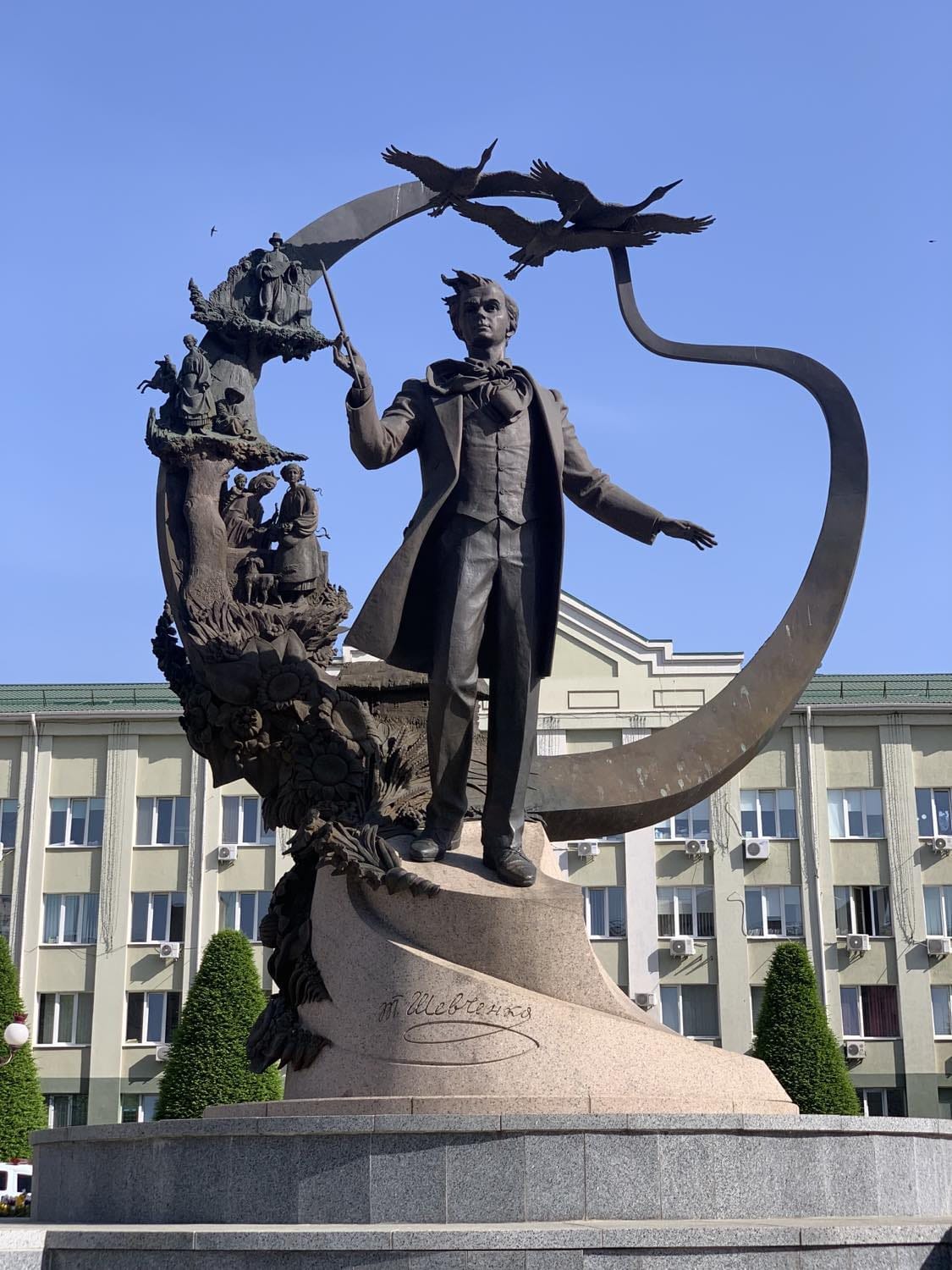
But he can also look like that; a wild-haired dreamer in the Keats mode. I would not have recognised him, I admitted to Oles when showed me the head of the sculpture, now sitting in his and Borys’ workshop in Kyiv.


Shevchenko’s look is part of a strategy…
Oles: This is part of the monument to young Taras Shevchenko in Irpin. He wanted to be an artist and studied painting, but he was a serf until other artists bought him out of serfdom.
We depicted him at a moment when he’s still young, when he’s a dreamy artist who will paint Ukraine. You see Ukrainian symbols: flowers, landscapes. Later in life when he was arrested and conscripted into military service [as a form of exile], his appearance changed. His moustache look was heavily shaped by Soviet narratives, to make him seem harsher. But in reality he was a very charismatic and energetic person for most of his life and was only worn down by exile and illness. We want to dismantle the stereotype.


Oles: We work with Lithuania a lot, and a lot of our work is there. They were also occupied by Russia for a long time. This is Petras Vileišis, a famous Lithuanian entrepreneur who printed a lot of books in the Lithuanian language, when it was forbidden. He helped renew it.


Oles: And this is a presidential-level project between Lithuania and Ukraine. A monument to Konstantin Ivanovich Ostrozhsky. When Ukraine was part of the Polish-Lithuanian Commonwealth, he fought many battles against Muscovy and won them all. At one major battle, in present-day Belarus, he was outnumbered two or three to one but still achieved a decisive victory. After that, Muscovy did not attack for nearly a century.
The monument is made of Italian red marble with white elements, and it’s the only one in Ukraine in a classical Renaissance–early Baroque European style. We’ve been working on it for over ten years. Part of it is already in a Lithuanian cathedral. But the whole thing is eight metres tall.
And this is what Oles and Borys do. They shape Ukrainian identity in clay, and forge it in bronze. I visited their workshop at the start of May, with a vague idea that I would be shown a lot of large stone… things, but of course very few Ukrainian artists are afforded the luxury of being apolitical, even if they want to be. And the more physically enduring the art form, the heavier the weight of representation.
Oles also serves in the National Guard, and he has come to regard that and his sculpture as all part of the same drive for victory and survival, which are basically the same thing for Ukraine.
Oles: I serve in the National Guard, and we do a lot for the army. We make these [medals] in our free time. Rewards for the commander to hand out. There are lots of different kinds. We do commemorative coins, plaques, memorials. There’s a lot of emphasis on boosting morale at the moment, motivating people a bit.
How do you balance art and service?
It is difficult. But there are more and more opportunities for cultural work. Over time there have started to be more and more tasks related to art. We create motivational materials. We have meetings with historians; currently we’re creating a museum for our unit. We’re breaking the Soviet stereotypes that persist in the army, trying to root them out. We’re writing the true history of these things, in the form of objects. Not just something you can read, something you can hold in your hands.


You feel that art is important during wartime?
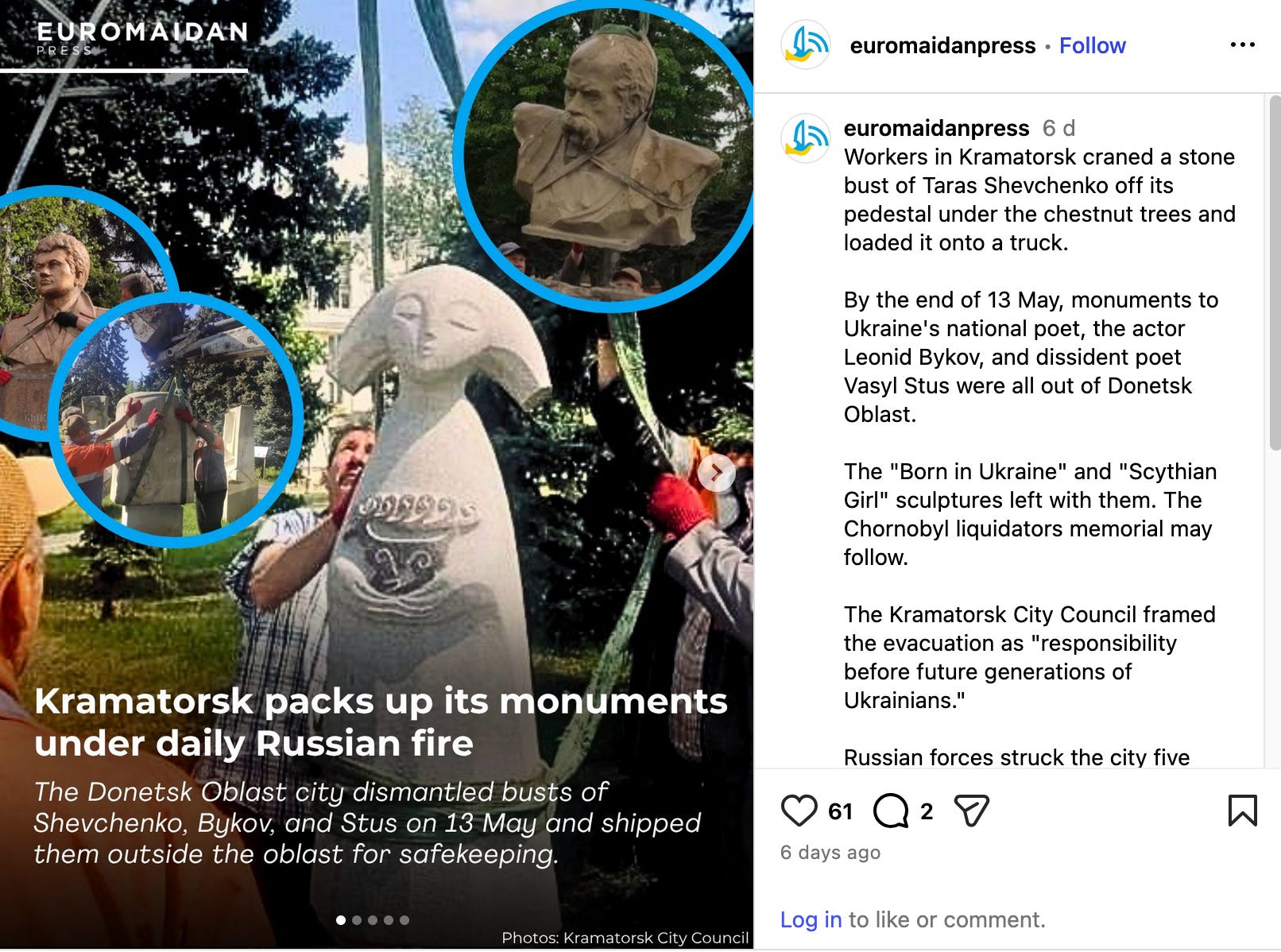
Of course. Though at first I didn’t think so. When the invasion happened and I joined the army, I thought art couldn’t exist in tandem with war. Later I realised that, on the contrary, art helps. It helps in understanding a lot of things. We are fighting for our land, where we sow grain, but we’re also fighting for our culture and identity. First and foremost, Muscovy – Russia – is trying to destroy our identity. Art challenges the idea that we have always been Russia. Our task is to break that stereotype. And art is one of the important things that helps us. Not just the military but civilians.
When Russia seizes territory, the first thing they do is destroy museums, remove and dismantle monuments. They try to destroy everything connected with the concept of Ukraine. And the people they arrest and kill first are those who promote Ukrainan culture. So in fact art and culture are very important during war.
A lot of art and sculptures have already been destroyed by Russia?
A lot have been stolen. For example when they seized Crimea. They took everything from the museums in Kherson under the pretext of a travelling exhibition or something. Really they just stole it and carried it off to Russia. They’re trying to destroy everything, to change our land entirely, so nothing exists here any more. Then they will resettle it, like. during the Holodomor of 1932-33.
Is all your art connected with war at the moment?
Borys: Not all of it. But it’s important that our art doesn’t just work in Ukraine, it’s even more important as international diplomacy. At the parliament in London we presented these sculptures, made of shell casings. Soldiers brought them from the front line, where they had destroyed a Russian munitions depot, using British weapons specifically.
The shell casings were torn apart and this is what is left of them. The idea was to show European society how effective this kind of aid is. Our British colleague, Stephan Duncan, worked on this project with us and wrote a poem for each shell casing.


Borys quoted in the promotional material for the London exhibition: Just as a mask covers a face, Russia has been trying to cover Ukrainian culture with its own culture for several years. By protecting their cultural identity, Ukrainians retain the ability to resist Russian aggression. The idea of creating this sculpture was born as a result of communication with the first veterans of the Russian-Ukrainian war who returned from military service in 2015.
The Voices from Ukraine exhibition ran at Lambeth Archives for three weeks in April 2026.
Did you work on these kinds of patriotic projects before the war, or was it a big change after the full-scale invasion?
Oles: Our direction has always been historical and religious. We work mostly with historical figures. Monumental scultpture is… propaganda. That’s not a very nice word! It’s the popularisation of the idea of Ukraine through monumental sculpture. Borys and I have been working in this direction for 30 years. We chose our own paths in life.
When did you decide you wanted to be a sculptor?
Oleg: As a child I lived near an art school. Things developed gradually, I didn’t wake up one morning and decide to become an artist. From childhood, I had an awareness that I would do that. Then I went to art school, then the academy, where I met Borys. We were studying on the same course. And we’ve been working together since 1996.
Borys: There was nothing special about my decision. I finished school and my father asked me what I wanted to do next. He suggested either a technical institute, or an academy, or art school. Of course, I chose art school because my father was an artist. He helped me on my way so it was simple.
Are all your projects collaborations?
Oles: Yes.
What does that mean for how you work? For example, he does the arms and you do the legs?
Both laugh. Hey, I got a D in my GCSE (exam taken at age 15) Art…
Oles: We have a shared goal so we find understanding.
Borys: We’re both professional sculptors. We can sculpt eyes, giraffes, grass, anything.
Oles: In reality there is some specialisation, though it’s not very pronounced.
Borys: Whoever arrives first does what he wants!
Told you there’s a system.
Can you show me your equipment?
Behold…
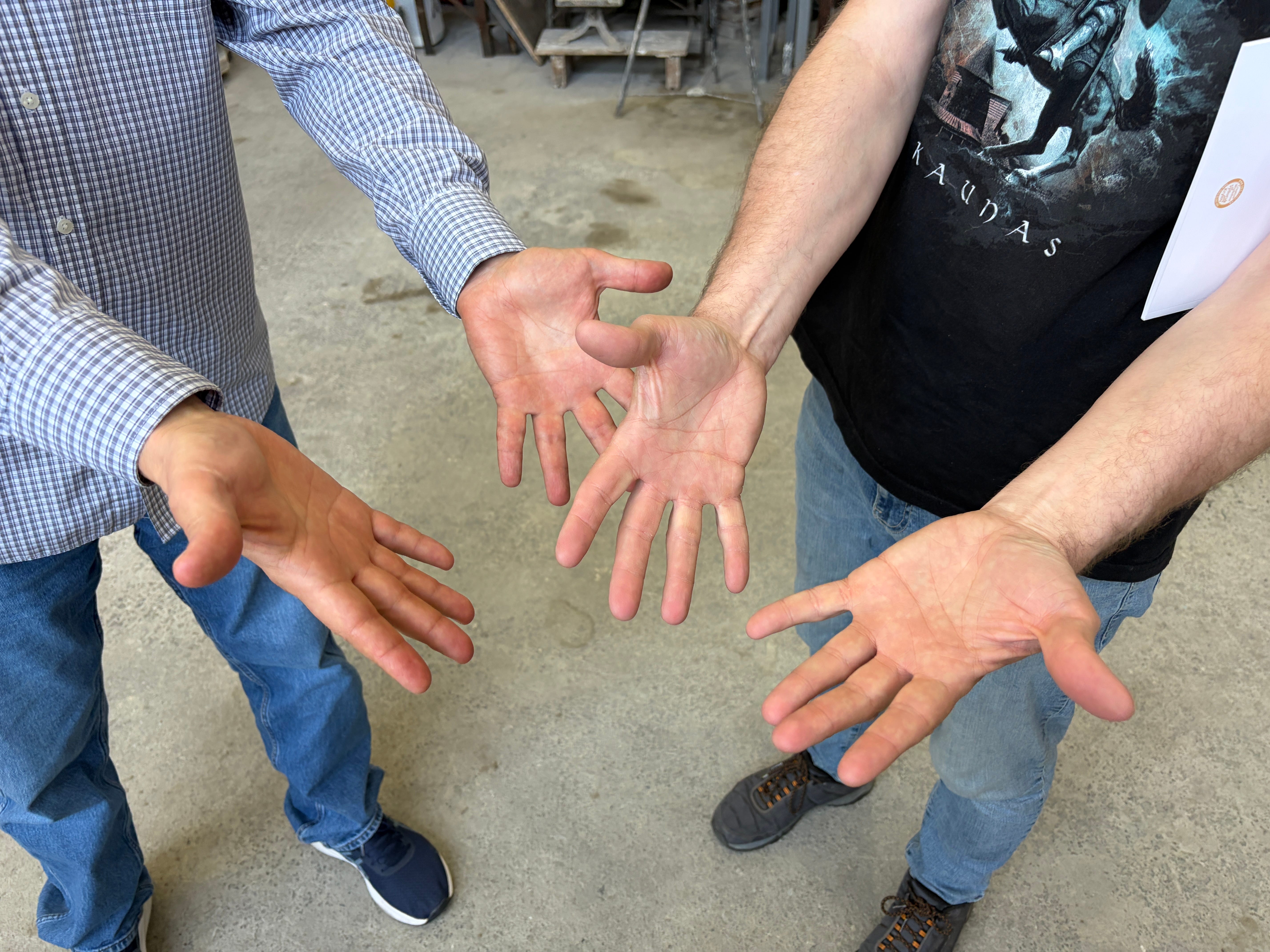
Borys: This is the real professional equipment!
But I also did take a look at some more specialised kit.


Oles: These are the furnaces where bronze is melted, and then it’s poured into a special mould. But to make the mould, first you need to make a wax model.
Borys: The clay comes from Chasiv Yar, which is now occupied territory. Back in 2014 we brought the last ten tonnes of clay from there. Now there’s no more, the quarry has been destroyed. We can reuse this many times, it doesn’t get thrown away. We chuck it in here, pour water over it and use it again.

If Russia attacks Kyiv again, what are your plans?
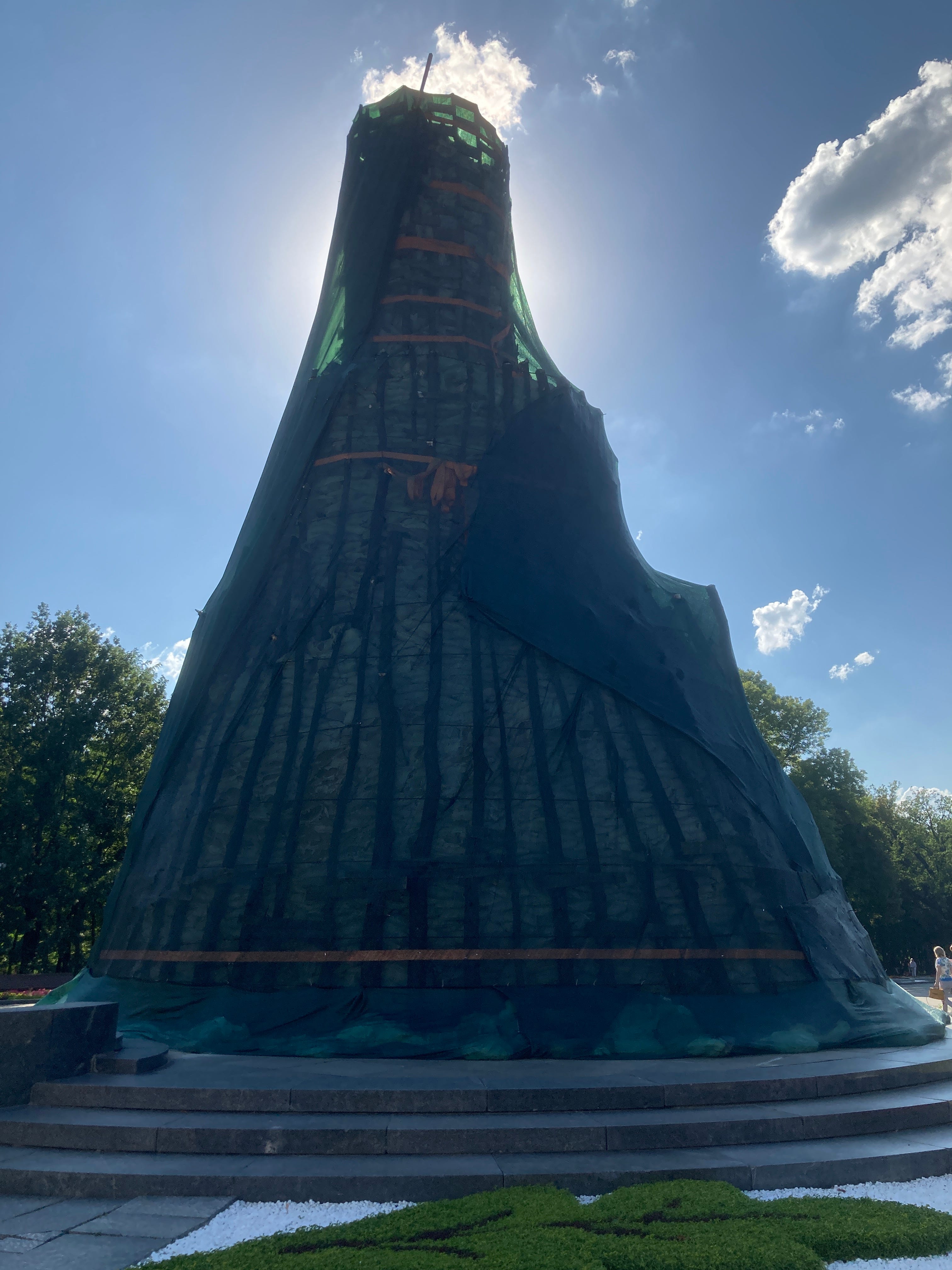
Oles: I will stay here to protect our sculptures. As we mainly work with monumental sculptures, our work has mostly been covered with sandbags to protect it. This has been done all around Ukraine.
We don’t really make plans, because it depends on where the military leadership sends me. But I don’t think there will be a sudden attack on Kyiv, like in 2022. There are troop movements and so on going on in Belarus at the moment, but we are prepared. The border is prepared so they won’t get here quickly. They aren’t even able to capture Donetsk oblast at present and Kyiv is further away. So I don’t think it will happen quickly. Hopefully not at all!
At present there are no plans for Borys and Oles’ work to tour the UK again, but it is possible to follow and support Ukrainian visual art here. The Ukrainian Cultural Association in the UK is a good place to start. There are similar associations in other countries too, such as the US Ukrainian Art Center.
"...sculptures, made of shell casings": this is brilliant! If life gives you sherll casings, make art with them! It reminds me of that insulted Muslim who said: "I am incense, the more you burn me the more I perfume". Artists can't be beaten!
Thank you Anna as always 🙂👍