
Two Soldiers' Stories
Back in Kramatorsk in April, I visited a military hospital and had the chance to speak with two of the guys recuperating there...

OLEKSANDR: A DAY IN THE LIFE
What is life like on position?
At the start, we arrive at a position bringing food with us: meat, eggs, pasta, bread. And a gas cylinder, and pots and pans. We take it in turns to cook.
There’s five or six guys there, if it’s an artillery position. We look after ourselves, so to speak.
We wake up in the morning and drink coffee. If there’s no order to fight, then we rest in the dugout and wait for an order. Everyone does his own thing. One guy reads, another one listens to music… but we’re always listening to the radio, we’re always in contact [with headquarters]. The radio is either with the senior artilleryman at the firing position or with the group and messages come through like ‘go on duty’ or ‘stand down’. That’s how we live.
At night, there are shifts [listening to the radio]: a guy spends three hours listening to the radio, then reports. That’s how the day goes.
How many people are in the dugout?
Six or seven guys. Sometimes guys who are moving further forward, closer to the contact line, stay with us overnight then move on. We try to enlarge the dugout a bit for them.
How far away are you from the contact line?
Artillerymen are about four or five kilometres from it. That’s our working distance.
That’s a long way. The conventional image of trench warfare is that you are much closer to the Russians.
Well, it sounds like a long way but it does feel like the Russians are right there. Especially now with so many drones. The hardest thing is getting to the position [because of the danger of drone attack on the way]. Being there isn’t so bad. Then working is hard, because if we’re using a self-propelled artillery system we have to drive out and stay in the open air. At any moment an FPV drone can hit and destroy you and your equipment.
And there are also ground drones?
Yes, robotic ground systems. They mainly deliver supplies. Guys on position place orders and those in the rear buy or receive the supplies [from donors or the state]. Food, cigarettes – everything is packed into bags, then the robot is driven to the position by remote control, using Starlink. There it’s unloaded, and it can be sent straight back.
How long do you stay on position?
Generally about a month. Then you leave for five days’ rest – you have a bath, you shave, you get yourself together a bit. Then you go back, either to the same position or a new one needs to be set up and you have to build it.
What kind of equipment do you have on position?
We have a petrol generator, an Ecoflow and a Starlink. As well as basic things like plates, spoons and pots. One time, back in 2023, we had a portable fridge.
Are there any women? Or foreigners?
No, the medic in our unit is a man. We don’t have any foreigners [though other units do] – but in 2022 I trained in Britain. I was called up in 2022 and went there for basic training.
How long were you there?
The training lasted 24 days, and I really enjoyed the experience. Especially the final exam. We advanced as a unit, crossed fields and barbed wire and ruins, and also cleared ruins [of enemies] and defended a building.
Did you like our food?
Yes, it was tasty but the problem was the lack of bread! You got toast in the morning and that was it.
I see you have a recent scar on your forehead…
This is my second injury in a short time. I didn’t want to go to hospital at first because it’s hard to leave the position.
It’s very hard to evacuate wounded soldiers.
Yes. I’ve evacuated other wounded guys myself more than once. Russian artillery heavily damages the roads, it’s very difficult.
One last thing I want to say… war is complete nonsense. It would be better if it never existed, anywhere.
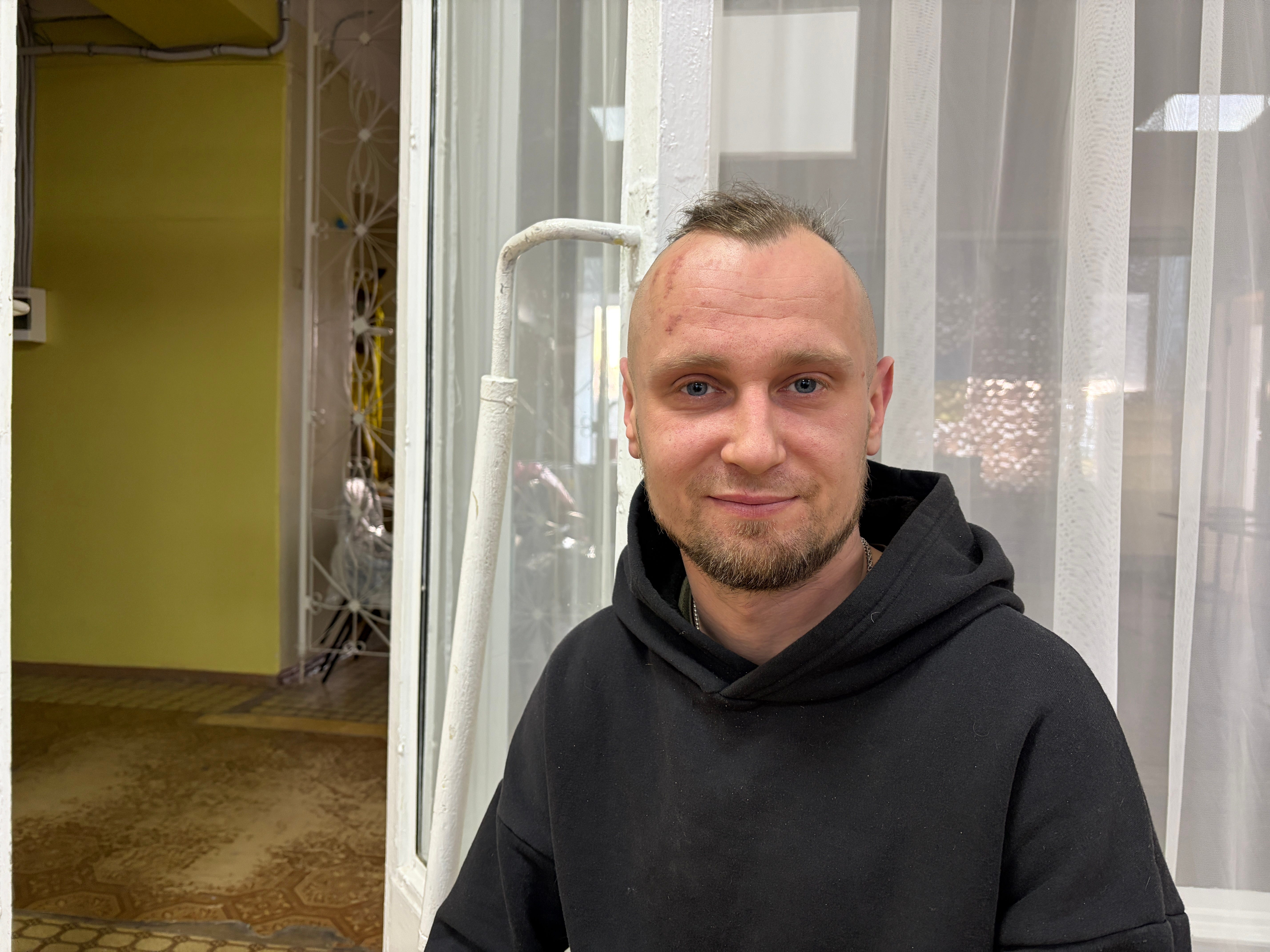
BOHDAN: A TYPICAL MISSION
Before I opened my mouth to ask questions, Bohdan got in first.
My name is Bohdan and I’m from the city of Uman. I was mobilised in 2022 and ended up in a rocket artillery battalion, that fires Grads. And I want to tell you a story.
They were sending two volunteers from each unit to clean out a village. My friend and I put ourselves forward. They told us there would be one or two, or maybe three enemies there.
But they lied. There were one, two or maybe three enemies in every house. In every basement. We went out in a group of four, heading out on our assigned task. On the first day, one group captured prisoners. Frankly, that was a big mistake. According to the Geneva Convention, you have to take care of prisoners – give them water, feed them – so the mission stalls.
We had to move through the forest to the village and check for enemies. Then the commander told us over the radio to move into the village. My friend was with me, but about 80% of the guys had never seen combat before, and they were being sent on what was basically an assault. We headed through the forest, waded through rivers, getting filthy and exhausted.
We came to the village and in the very first house there was an enemy soldier. We had to kill him – what could we do, it was terrifying. He had a radio and [the Russians] were reporting their positions on it: ‘We’re in the fourth house, the one with the green roof, and we need food and water.’ So we were standing at the window counting – one, two, three, four – okay, that’s where they are.
We secured one street, then another. The commander had told us not to go beyond the village – we were just supposed to complete the task and be evacuated. But we completed the mission in five or six days and I don’t know what got into him – maybe ambition – but he told us to push on. We secured the last house, then we were sent on again. We went on and cleared more areas of the enemy, even though we took losses.
We were moving through a tree line, then crossing into an open area, and there was a ‘waiter’ drone. You know, they sit on the road and wait for vehicles. We’re running and its motor switches on and it flies at us.
We shot at it, and it blew up. Then I got on the radio reporting that [the Russians] were co-ordinating and they would probably throw everything they had at us. I suggested we fall back and continue the next day. But the commander said shelter was closer ahead of us than behind us. Like, go onwards!
I don’t know why I listened to him. We advanced, and [the Russians] opened fire on us from that building. Chaotic, bullets everywhere. It was terrifying when bullets started flying around like that. We took cover behind the trees and I fired back to cover my guys as they retreated.
They retreated and I expected them to return fire so I could retreat, but they just ran. I was left under fire, so scared. I took a risk and ran, with bullets slamming into the ground around me. It was terrifying. [Bohdan is smiling all through this story, a slight laugh in his voice, as many soldiers do]. At one point I yelled, ‘Quiet!’
We heard a buzzing sound in the sky. Masses of drones, just hordes of them. They started exploding. The guys panicked – it was their first time in combat – and grouped together. A mortar got between my friend and another soldier and they were immediately wounded. I was the commander of that group and I was terrified and hopped up on adrenaline. They were shouting for help but I knew how adrenaline works: if I started to help them now they’d start to rely on my help and we’d all be stuck together.
So I shouted: “Run toward my voice! You can do it!” Trying to keep them moving.
We kept running. There were maybe ten FPV drones and one flew straight at me. I dodged and it hit a tree and exploded. Then a mortar shell exploded and threw me into the air. I landed and thought for a second, maybe I’ll just lie here. But the adrenaline kicked in and I got up and ran on.
We reached the dugout and I saw my friend running along with a drone chasing him. I shouted for him to come to me, warning him, and he jumped into a ditch and the drone went in after him.
This wasn’t just a brother-in-arms, this was my childhood friend. I ran to him, saw him lying there, checked for a pulse but couldn’t find it in his wrist. And I was bleeding too. I tried using the radio, but of course it picked the worst possible moment to stop working. I walked a bit then sat, then decided to put a tourniquet on myself, then go and report. I’d just got the tourniquet on, and I was coming out of the dugout, when someone shouted ‘Popeye! Sailor! Where are you?’ Popeye is my callsign. Turns out, my friend had already made it to the guys on his own.
Wow. A will of iron. He was completely smashed up, but he got out by himself [laughs]. What a great guy. He went to Kyiv and they amputated his left arm.
That’s how it was. That’s my little story.
There’s one more thing I want to say about war: it’s terrifying. I wouldn’t wish it on anyone.
Thanks to Jude Ellison for proofreading this post.
There are a lots of ways to donate to the Ukrainian army, but one good option is Jack and Masha, volunteers who devote themselves to supplying the soldiers with everything from fire extinguishers to socks to drone controllers. Donations are welcomed at at Jack’s buymeacoffee page or Masha’s PayPal at kabanetsmariya@gmail.com.
Whenever you hear from soliders you always wonder how anyone could possibly survive what they go through.
Good reporting as always Anna, thank you.